Write by Guillaume Lourmiere the 26 February 2026
This article is based on the work of Mr M.B. New for the FAO, on the book of Dr G. Laval and on my personal knowledge.
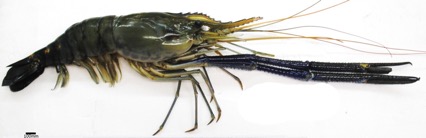
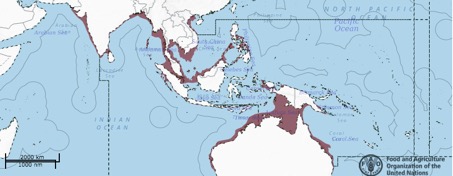
The giant freshwater prawn, Macrobrachium rosenbergii, is a prawn that can live in freshwater but needs brackish water to reproduce, so in the wild it only lives along the coast. It is native to a vast geographic area stretching from the coasts of Pakistan in the west to the northern coasts of Australia in the east, passing through the coasts of the Indian subcontinent and those of Southeast Asia, and it is limited in the north to the southern coasts of China.
This shrimp is already well known in aquaculture; scientists have perfectly described its biology, and its full production cycle is totally mastered. However, it has not achieved the same success as its “cousins,” vannamei and monodon, for behavioral reasons. Indeed, Macrobrachium rosenbergii cannot be produced at high densities, as it is a territorial species that engages in cannibalism when it is too concentrated. Therefore, on the same surface area, it cannot be produced in the same quantities as its two “cousins.”
But the behavior of this species is not the only explanation for this lack of interest. Farming Macrobrachium rosenbergii is economically profitable in most cases, but far less than the two other mentioned species. Consequently, the main reason for the lack of development and interest in its farming is economic. Shrimps and prawns in general are highly valued products, and most countries which are able to farm them, mainly tropical countries of the “Global South”, have chosen to focus on a production for export to “Northern” countries (mainly the USA and the EU), which are major shrimp consumers but produce very little themselves, whether through fishing or aquaculture. This export-oriented production, strongly linked to neoliberalism and neocolonialism, depends on Northern suppliers (feed, chemicals, medicines, equipment, etc.), free-trade agreements, cheap labor exploitation, and consumer demand that constantly seeks more quantity at ever lower prices. All of this comes at the expense of product quality, local consumption, essential ecosystems (destruction of mangroves, discharge of pollutants into the environment), and workers (in the most extreme cases, slavery is involved, the FAO is currently investigating).
In the article “Tomorrow’s Aqua Long-Term Vision for Aquaculture,” it was noted that aquaculture must expand globally, but not anywhere and anyhow. It is at this level that the development of freshwater giant prawn farming becomes relevant and offers many advantages. Potentially, any country with a tropical climate could farm it, whether landlocked or not. Indeed, only the hatchery, reproduction and larval stages, require brackish water, which can easily be managed even in areas without access to seawater. In low-tech RAS systems, brackish water can be made as long as salt is available, which is the case in nearly everywhere. Furthermore, only this part of the production cycle requires a reliable electricity supply (for water and air pumps), which can be very challenging in remote areas, therefore, hatcheries must be built where the electrical grid is easily accessible.
The pre-growing and grow-out stages can be carried out without electricity, either in brackish-water ponds near the coast or in freshwater ponds in areas with little or no access to seawater. This has been demonstrated, for example, in the USA (Kentucky) and southwestern France. In tropical climates, freshwater is generally abundant due to numerous rivers and the rainy season (although climate change could threaten this abundance in some areas), and consistently high temperatures allow rapid prawn growth.
Farming Macrobrachium rosenbergii does not require high-tech systems, as mentioned before, simple low-tech RAS systems are sufficient to breed it successfully. Therefore, even countries with limited financial resources could invest in small hatcheries (cooperative or public) using little or no imported equipment. The most delicate and expensive part, for countries where the freshwater giant prawn is not native and has not yet been farmed, is to import broodstock. This require precise logistics to import adult prawns in optimal conditions, fortunately, these prawns are robust animals. Additionally, it is important to find multiple suppliers to maximize genetic diversity and avoid inbreeding, which would inevitably harm the farming operation.
It should be noted that the potential for nuisance of Macrobrachium rosenbergii should not be underestimated. Indeed, along coasts where it is not native, if it escapes from farms, it could become an extremely invasive species, causing significant harm to local ecosystems. However, to confirm this, the introduction of this shrimp in non-native areas (in Africa or in South America for example) needs to be monitored scientifically. In inland areas or landlocked countries, this issue does not arise, because it is a prawn that cannot reproduce in freshwater, therefore, even if it escapes, it will eventually die without producing offspring.
A major advantage of this prawn is that it is detritivorous and can feed largely on the natural productivity of ponds, greatly reducing the need for feed inputs. As a result, grow-out costs are very low, only broodstock and larvae require high-quality aquaculture feed.
Another benefit is that this farming can be integrated with other aquaculture and agricultural productions. For example, in some parts of Southeast Asia, these prawns are farmed alongside rice culture. Therefore, wherever rice grows, Macrobrachium rosenbergii could potentially be farmed. Also, other integrated multi-trophic aquaculture (IMTA) systems can be explored. It can also be raised on the coast while preserving mangroves, which, once again, are essential for protecting tropical coastlines against rising seas and for the biodiversity of marine species, many of which grow in mangroves.
Developing Macrobrachium rosenbergii farming can also contribute, in highly poor regions, to the food sovereignty and security of local populations who lacks animal protein, helping to reduce malnutrition. Additionally, it contributes to reduce unemployment in rural areas experiencing depopulation due to a lack of economic activities, increase farmers’ incomes, and create economic opportunities for women, who are unfortunately too often marginalized in many places.
All these reasons explain why Tomorrow’s Aqua strongly believes in developing Macrobrachium rosenbergii farming. Consequently, Tomorrow’s Aqua is committed to sharing available knowledge about the freshwater giant prawn, promoting its farming wherever possible, establishing new prawn farming projects and supporting all public and private initiatives that align with this goal.
References
FAO. 2002. In: M. B. New, eds. Farming freshwater prawns A manual for the culture of the giant river prawn (Macrobrachium rosenbergii). Rome, Italy, Food and Agriculture Organization of the United Nations.
FAO. 2025. Macrobrachium rosenbergii De Man,1879. In: Fisheries and Aquaculture. https://www.fao.org/fishery/en/aqspecies/2608/en
Laval, G. 2022. In: G. Laval, eds. Élevage de crevettes d’eau douce en Europe Pratiques éco-responsables pour Macrobrachium rosenbergii. Versailles, France, Éditions Quae.
Silva-Oliveira, G., Ready, J., Iketani, G., Bastos, S., Gomes, G., Sampaio, I., Maciel, C., 2011. The invasive status of Macrobrachium rosenbergii (De Man, 1879) in Northern Brazil, with an estimation of areas at risk globally. Aquatic Invasions. DOI: 6. 10.3391/ai.2011.6.3.08.